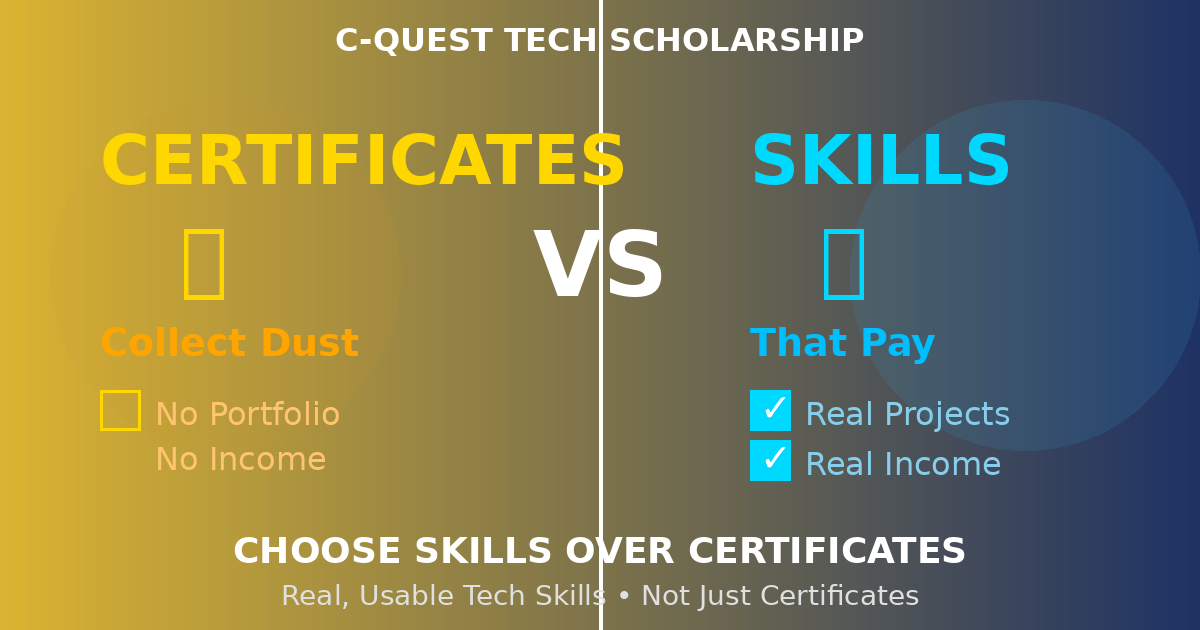
Skills That Pay vs Certificates That Collect Dust: Why C-Quest Does Tech Training Differently
Keywords: tech skills vs certificates, practical tech training, job-ready tech skills, tech training that works, C-Quest real skills, employability tech training Nigeria
Let me ask you a direct question:
Would you rather have a certificate on your wall or money in your bank account?
Seems obvious, right? Yet thousands of Nigerians are still chasing certificates while wondering why they can't get hired or land clients.
Here's the uncomfortable truth: The tech industry doesn't care about your certificates. It cares about what you can DO.
And that's exactly why C-Quest IT Hub Tech Scholarship is different. They don't promise you a fancy certificate. They promise you "real, usable tech skills, not just certificates."
Today, I'm going to show you why this distinction matters and why it could be the difference between another unemployed certificate holder and an employed tech professional.
The Certificate Trap: How We Got Here
First, let's understand how we ended up in this situation.
The Traditional Education Model
You've been conditioned to believe:
- Go to school → Get certificate → Get job
- More certificates = Better opportunities
- Certificate = Proof of knowledge
This worked... in 1990. Maybe even in 2000.
But in 2026? The tech industry has completely moved past this model.
What Actually Happens
Here's the reality for most certificate collectors:
Month 1: "I got my certificate in Python programming!"
Month 3: "Why isn't anyone hiring me?"
Month 6: "Maybe I need another certificate in machine learning?"
Month 12: "I have 5 certificates and still can't get a job..."
Sound familiar?
The Problem With Certificate-Focused Programs
Most tech programs are designed to give you certificates, NOT to make you employable. Here's why:
1. They Teach Theory, Not Practice
You learn definitions, syntax, concepts. But you don't build anything real.
Result? You can pass tests but can't build a functional website or analyze actual business data.
2. They're Not Connected to Real Work
Projects are artificial. "Build a calculator app." "Create a todo list."
Real clients need: "Build a booking system for my hotel." "Analyze my sales data and tell me why revenue dropped."
3. They Don't Teach Problem-Solving
You memorize code. You don't learn how to debug errors, Google effectively, or figure things out independently.
When you hit a real problem at work, you freeze.
4. No Portfolio Development
You complete assignments for grades, not for your portfolio.
When an employer asks "show me what you can do," you have nothing to show.
5. Focused on Completion, Not Competence
The goal is to finish the course and get the certificate, not to ensure you're actually job-ready.
Many people graduate "certified" but unemployable.
The C-Quest Difference: Skills Over Certificates
Now let's look at how C-Quest IT Hub approaches tech training differently.
Their Core Philosophy
"Real, usable tech skills, not just certificates."
This isn't just marketing. It's fundamentally different from traditional programs. Here's what it means:
1. Practical Over Theoretical
Traditional Program:
- 70% theory
- 20% examples
- 10% practice
C-Quest Approach:
- 20% theory (just enough to understand)
- 80% hands-on practice
- Real-world applications from day one
You're not just learning ABOUT data analysis. You're ANALYZING real data.
You're not just learning ABOUT web development. You're BUILDING real websites.
2. Real Projects, Not Toy Examples
Traditional Program Projects:
- "Build a calculator"
- "Create a contact form"
- "Make a simple game"
C-Quest Projects:
- Build a professional portfolio website
- Create a complete brand identity for a business
- Analyze business data and present insights
- Develop a functional web application
These are portfolio pieces you can show employers or clients.
3. Skills That Translate to Income
C-Quest focuses on teaching:
- What employers actually need
- What clients actually pay for
- What works in the real Nigerian market
Not just what looks good on a curriculum.
4. Mentorship That Continues Beyond Class
Traditional Programs:
- Teacher delivers lecture
- You take notes
- Class ends, you're on your own
C-Quest:
- Live classes with interaction
- Direct access to tutors
- Mentorship continues after program
- Alumni community support
You're not abandoned after getting your certificate.
5. Job Readiness, Not Just Course Completion
C-Quest includes:
- Portfolio building
- LinkedIn optimization
- CV reviews
- Interview preparation
- Freelancing guidance
You don't just learn the skill. You learn how to SELL the skill and GET PAID.
The Five Pillars of "Real, Usable Tech Skills"
Let's break down what makes a tech skill "real and usable":
Pillar 1: Immediately Applicable
Certificate-Level Knowledge: "I learned Python syntax and functions."
Real Skill: "I can write Python scripts to automate business processes and save companies time."
The Difference: One is information. The other is capability.
C-Quest ensures you can actually DO something with what you learn, not just talk about it.
Pillar 2: Portfolio-Ready
Certificate-Level: "I completed 20 exercises."
Real Skill: "Here are 5 projects I built that solve real problems."
The Difference: When someone asks "Can you do this?" you can show them proof.
C-Quest builds your portfolio DURING training, not after.
Pillar 3: Market-Relevant
Certificate-Level: "I learned every feature of this software."
Real Skill: "I learned the 20% of features that handle 80% of real-world needs."
The Difference: You focus on what actually gets you hired or paid, not exhaustive knowledge you'll never use.
C-Quest teaches what the Nigerian and global market actually needs RIGHT NOW.
Pillar 4: Problem-Solving Focused
Certificate-Level: "I can replicate this exact code from the tutorial."
Real Skill: "I can figure out how to solve problems I haven't seen before."
The Difference: One makes you dependent. The other makes you valuable.
C-Quest teaches you how to THINK, not just what to memorize.
Pillar 5: Income-Generating
Certificate-Level: "I have knowledge."
Real Skill: "I can deliver value that people/companies pay for."
The Difference: Knowledge is potential. Skill is currency.
C-Quest alumni like Gift, Michael, and Faith are EARNING from their skills, not just displaying certificates.
Real Talk: What Employers Actually Want
Let me share what employers tell me they look for:
What They DON'T Say:
❌ "Do you have a certificate?" ❌ "Did you score 100% on your tests?" ❌ "Can you recite the theory?"
What They DO Say:
✅ "Can you solve this problem?" ✅ "Show me what you've built." ✅ "Can you start contributing immediately?" ✅ "How quickly can you learn our tools?" ✅ "Can you work independently?"
Employers hire problem-solvers, not certificate collectors.
The Interview Reality
Certificate-Focused Candidate: Interviewer: "Can you build us a dashboard to track sales?" Candidate: "Well, I learned about dashboards in my course..." Interviewer: "But can you build it?" Candidate: "I... I'm not sure..."
Skills-Focused Candidate (C-Quest Alumni): Interviewer: "Can you build us a dashboard to track sales?" Candidate: "Yes. Here's a similar dashboard I built during my training. I used [tools]. I can adapt it to your needs." Interviewer: "When can you start?"
See the difference?
The Portfolio Effect: Why Projects Matter More Than Certificates
Here's something most people don't understand:
Your Portfolio IS Your Resume in Tech
In traditional careers:
- List your degrees
- List your certificates
- List your experience
- Hope they believe you
In tech:
- Show what you've built
- They can SEE your capability
- Your work speaks for itself
What a Real Portfolio Looks Like
Bad Portfolio (Certificate Mentality):
- "Completed Python course"
- "Earned certificate in web development"
- "Studied data analysis"
Good Portfolio (Skills Mentality):
- "Built e-commerce site with payment integration - [link]"
- "Analyzed 3 years of sales data, identified 15% cost savings - [case study]"
- "Designed complete brand identity for local restaurant - [portfolio piece]"
Which one would YOU hire?
C-Quest's Portfolio Approach
During the 3-month program:
- Month 1: Foundation + first simple project
- Month 2: Intermediate projects building on skills
- Month 3: Capstone project - comprehensive, portfolio-ready
By graduation, you have:
- 3-5 portfolio pieces
- Real work to show
- Proof of capability
Not just a certificate saying you attended.
The Economics: ROI of Skills vs Certificates
Let's talk money because that's what really matters:
Certificate-Focused Program Economics
Investment:
- Course fee: ₦100,000 - ₦500,000
- Time: 3-6 months
- Certificate obtained ✓
Return:
- Can't get hired (no practical skills)
- Can't freelance (no portfolio)
- Takes more courses
- More certificates
- Still struggling
ROI: Negative. Money spent, no income generated.
C-Quest Skills-Focused Economics
Investment:
- Course fee: ₦0 (fully funded)
- Processing fee: Small (for selected candidates)
- Time: 3 months training + practice
Return:
- Portfolio-ready projects
- Job applications with proof
- Freelance capability
- First income within 4-6 months
- Growing career
ROI: Positive. Minimal investment, income generated.
The Income Timeline Comparison
Certificate Collector:
- Month 6: Still looking for opportunities
- Month 12: Maybe entry-level role at ₦60,000
- Month 18: Still ₦60,000-₦100,000
Skills Developer (C-Quest):
- Month 6: First paid work ₦50,000-₦150,000
- Month 12: Consistent ₦150,000-₦300,000
- Month 18: ₦250,000-₦500,000+
The skills approach accelerates earnings.
What "No Prior Tech Experience Required" Really Means
Let's address this because it's crucial:
Traditional Programs Say This But Mean:
"No prior experience required*"
*But good luck if you:
- Can't figure things out independently
- Need actual help when stuck
- Don't have a tech-savvy friend to ask
- Get overwhelmed by jargon
Result: High dropout rate. People feel stupid. Give up.
C-Quest Actually Means It
When C-Quest says "No prior tech experience required. Just commitment," they mean:
They Provide:
- Patient instructors who explain things clearly
- Live classes where you can ask questions
- Recorded sessions to rewatch difficult topics
- Direct tutor access when you're stuck
- Supportive community of fellow learners
- Step-by-step guidance
You Provide:
- Willingness to learn
- 5-7 hours weekly commitment
- Persistence when things get challenging
Fair exchange.
The Proof: Gift's Story
Remember Gift from Port Harcourt?
"Before joining C-Quest IT Hub, I had zero coding experience. Within three months, I could build and deploy responsive websites."
Zero. Not "a little." Zero.
And now? Working remotely for an Abuja startup.
That's what "no prior experience required" looks like when it's real.
The "5-7 Hours Weekly" Reality Check
Let's be honest about time commitment:
What Traditional Programs Say:
"Learn at your own pace!"
Translation: "We don't care if you actually finish or learn anything."
What C-Quest Says:
"5-7 hours weekly required."
This is honest. This is realistic. This is achievable.
Breaking It Down:
5 hours minimum:
- 3 hours: Live classes (2-3 sessions weekly)
- 2 hours: Practice and assignments
7 hours ideal:
- 3 hours: Live classes
- 2 hours: Practice
- 2 hours: Personal projects and review
That's 1 hour daily or 2 hours every other day.
Everyone has this time. You're spending more than that on social media right now.
The Commitment Test
Can you commit 5-7 hours weekly for 3 months?
If YES: You can do this. The skills are learnable. The support is there. You just need to show up.
If NO: Don't waste your time or theirs. Wait until your life allows this commitment.
Honesty matters.
The Support System: Why You Won't Do This Alone
One massive advantage of C-Quest over self-learning:
Self-Learning Reality:
- You're alone with YouTube and Google
- No one to ask when stuck
- No accountability
- Easy to give up
- No community
- No portfolio guidance
- No career support
Result: 95% give up within weeks.
C-Quest Support System:
During Training:
- Live instructors answering questions
- Direct tutor access
- Classmate community
- Structured curriculum (no wandering)
- Accountability (people notice if you disappear)
After Training:
- Alumni community
- Continued mentorship
- Job/freelance guidance
- LinkedIn and CV help
- Network of professionals
Result: Much higher completion and success rate.
The Real Questions You Should Ask
Forget "Is it accredited?" or "Will I get a certificate?"
Ask these instead:
Question 1: "Will I be able to DO something valuable?"
C-Quest Answer: Yes. You'll complete real projects building practical skills.
Question 2: "Will I have proof of my capability?"
C-Quest Answer: Yes. You'll have a portfolio of projects to show.
Question 3: "Will I know how to get paid for this skill?"
C-Quest Answer: Yes. LinkedIn optimization, CV reviews, freelancing guidance included.
Question 4: "Will I have support when I'm stuck?"
C-Quest Answer: Yes. Direct tutor access, community support, mentorship continues after program.
Question 5: "Is this what the market actually needs?"
C-Quest Answer: Yes. 10 courses focused on high-demand skills in Nigerian and global markets.
These questions matter more than certificates.
Making the Decision: Skills vs Certificates
Here's your choice framework:
Choose Certificate-Focused Programs If:
- You just want something on your resume
- You're not serious about career change
- You don't care about actually using the skill
- You prefer theoretical learning
- You want to check a box
Choose C-Quest (Skills-Focused) If:
- You want to actually earn from tech
- You're serious about career transformation
- You want practical, applicable skills
- You learn better by doing
- You want portfolio and job support
- You want to be employable, not just "educated"
Which one describes you?
The Application: No More Excuses
Every excuse for not applying is really saying "I'd rather collect certificates than develop skills."
"But I have no experience"
That's literally the point. Gift, Michael, and Faith all started from zero.
"But I don't have time"
5-7 hours weekly. You have the time. You're choosing to spend it elsewhere.
"But what if I fail?"
Failure is learning. The only real failure is not trying.
"But will I really get a job?"
With certificates? No guarantee. With real skills and portfolio? Much better odds.
"But it's free, so it must be low quality"
It's fully funded, not cheap. Big difference.
Check their partners: Paystack, Cisco, Zenith Bank. These aren't names associated with low quality.
Your Next Steps
If you're done collecting useless certificates and ready to develop actual skills:
Step 1: Visit the Application
https://cquestithub.com/scholar
Step 2: Choose Based on What You'll DO, Not What Sounds Cool
Pick a course based on:
- What skills the market pays for
- What matches your strengths
- What you can see yourself doing for income
Not just what sounds interesting.
Step 3: Commit to the Process
During training:
- Show up to live classes
- Complete all projects
- Ask questions when confused
- Practice beyond minimum hours
- Build your portfolio
After training:
- Keep learning
- Apply skills immediately
- Build more projects
- Network actively
- Get that first paid work
Step 4: Focus on Skills, Not Certificates
Measure your progress by:
- Can I build/do/create X?
- Do I have portfolio pieces to show?
- Can I explain my work to potential employers/clients?
- Am I getting closer to employment/income?
Not by:
- Did I get a certificate?
- Did I pass the tests?
Final Thoughts: Choose Capability Over Credentials
The tech industry has moved on from the "collect certificates, get job" model.
What matters now:
- Can you solve problems?
- Can you build things?
- Can you deliver value?
Not:
- How many certificates do you have?
- What was your test score?
C-Quest IT Hub understands this. That's why they promise "real, usable tech skills, not just certificates."
Three months from now, you could have:
- ✅ Practical tech skills
- ✅ Portfolio projects
- ✅ Career support
- ✅ Path to income
Or you could have:
- 📄 Anot